Wondering why two North Bay lakefront homes with similar square footage can sit $500,000 apart in price? On Lake Michigan, value is shaped by the water as much as the house. You want a pricing plan that captures every premium your property deserves without scaring off qualified buyers. In this guide, you’ll learn how frontage, view corridors, bluff position, and architectural quality combine with recent sales to set a strong, defensible price. Let’s dive in.
North Bay lakefront basics
North Bay sits on the Racine shoreline of Lake Michigan, where long sightlines, access to the water, and regional appeal draw buyers from the Milwaukee and Chicago corridors as well as local residents. Luxury listings here respond directly to recent closed sales, available waterfront inventory, and days on market for premium homes in Racine County.
The most reliable inputs for pricing come from local data over the past 12 months. That includes closed lakefront sales in North Bay and nearby Racine, plus active competition. Treat national averages as background only. Lakefront premiums vary widely across the Great Lakes, and North Bay’s bluff conditions, shoreline regulations, and buyer pool create a distinct micro-market.
Frontage and shoreline geometry
What “frontage” really means
Frontage is the linear shoreline length belonging to your parcel. It can be measured as a straight line on a map or along the curve of an irregular shoreline. Buyers respond to effective frontage, not just what the deed records. Dense vegetation, slope, or easements can reduce how much shoreline feels usable.
Why frontage drives price
More frontage often means more privacy and better functional use. It can allow space for stairs, small beach segments, or shoreline stabilization where appropriate and permitted. Many buyers and agents compare price per front foot, but that number must be adjusted for view quality, slope, and access.
How to factor frontage into value
- Start with comparable sales that have similar usable frontage and similar slope.
- Adjust for shoreline usability. A gentle slope or private beach segment typically carries a premium over a steep bluff with limited access.
- Account for shoreline improvements and permits. Docks, stairs, or stabilization work can add both utility and cost considerations.
- Consider irregular shorelines. Communicate both legal frontage and your best estimate of “usable frontage” to set expectations.
View corridors and bluff position
View quality, explained
Lake views are multidimensional. Angle to the water, distance from trees or bluff edges, seasonal changes, and orientation all matter. Panoramic open-water views tend to command higher premiums than partial or framed views that change significantly with the seasons. Buyers increasingly expect year-round view quality.
Bluff position and access
- Top of bluff: Often delivers the broadest views and privacy, but may come with stricter setbacks and higher perceived erosion risk.
- Mid-bluff or slope: Can limit yard usability and complicate access to the shoreline.
- Toe of bluff or near waterline: Offers easier physical access but may face more immediate wave and ice exposure.
Setbacks from the bluff edge affect where you can renovate or expand. Access solutions, such as well-designed stairs, can meaningfully improve perceived value when properly permitted and constructed.
Erosion and lake-level variability
Great Lakes water levels fluctuate over multi-year cycles, which can influence shoreline stress and bluff conditions. Protective measures like seawalls or riprap can mitigate risk in some cases, though they carry permit requirements, maintenance, and ecological considerations. Lenders and insurers pay attention to long-term erosion exposure, flood mapping, and structural stability, so pricing should reflect both current condition and foreseeable risk.
Permits, setbacks, and insurance
Wisconsin’s shoreland zoning and local municipal ordinances regulate structures near the ordinary high-water mark, bluff setbacks, and shoreline stabilization. In many cases, docks, piers, seawalls, or stairways require permits. Timelines and approval risk can influence your pricing strategy, since buyers weigh both usability and the certainty of keeping or enhancing access.
Insurance and financing are part of the equation. FEMA flood mapping, lender requirements, and underwriting standards for waterfront properties may affect a buyer’s costs and comfort level. When you can document flood zone status, elevation, prior stabilization work, and any geotechnical evaluations, you reduce uncertainty and help preserve value.
Architectural significance and quality
What qualifies as architectural value
Architectural pedigree, high-grade materials, engineered foundations suited for bluff conditions, and design choices that maximize sightlines can all support a premium. Historical significance or landmark status may add prestige and interest, though it can also bring constraints on alterations.
How buyers and appraisers treat it
Recognition matters. A well-documented design with desirable style and integrity in good condition tends to attract a wider luxury audience. When few direct comps exist, appraisers may rely more on qualitative analysis and elements of the cost approach to capture replacement value for unique features.
How to document the premium
- Identify the architect, year built, and any publications or awards.
- Catalog exterior systems and finishes, including windows engineered for lakeside exposure.
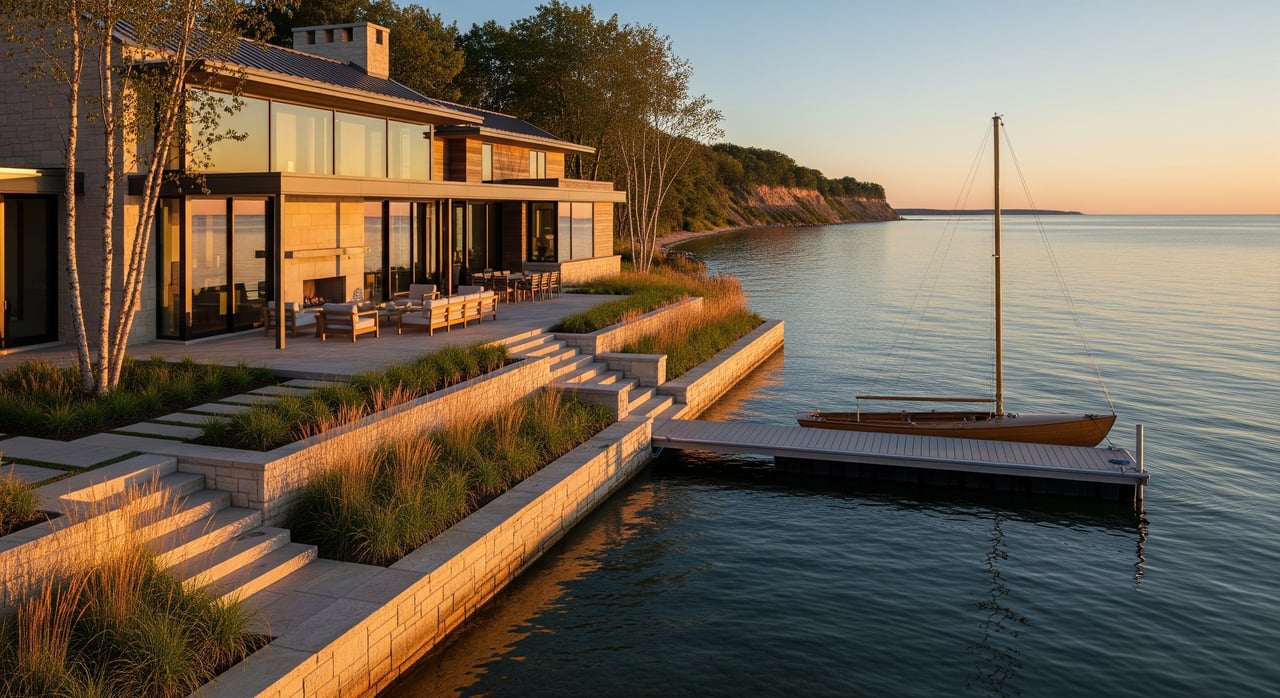
- Highlight site-specific design features like floor-to-ceiling glass and terraces that frame Lake Michigan views.
- Provide high-quality photography and virtual tours that showcase view corridors and the connection between the home and shoreline.
Build a defensible price with comps
Choosing the right comps
Start with closed sales of lakefront properties in North Bay or the Racine shoreline from the past 6 to 18 months that mirror your frontage, bluff position, and view quality. If inventory is thin, expand the search along the Lake Michigan coast while prioritizing properties with similar site attributes and buyer pools. Use active and pending listings to read the market, but give the most weight to closed sales.
Adjust for differences in:
- Frontage length and usable shoreline
- Bluff position, slope, and access
- View quality and orientation
- Architectural pedigree, materials, and condition
- Dock, stair, beach, or stabilization permits and their maintenance implications
Appraisal approaches to expect
- Sales comparison is primary for single-family luxury lakefront homes.
- The cost approach can support value for very unique properties where comparable sales are limited.
- Income approaches are rare unless the property reliably produces income, such as a legal multi-unit or compound.
A simple adjustment workflow
- Select three to six closed comps that are closest in frontage, bluff position, and architecture.
- Quantify key attributes for each comp, including view quality and shoreline improvements.
- Adjust for each material difference and document your rationale. If a comp required stabilization work post-sale, reflect that cost or risk in your adjustments.
- Reconcile the adjusted range into a pricing band based on seller goals, expected days on market, and current competition.
A seller’s checklist for North Bay lakefront
Gathering the right information upfront lets you price with confidence and answer buyer questions quickly.
- Deeded frontage and a practical estimate of usable shoreline
- Bluff position and distance from the bluff edge
- Slope steepness, access routes, and any stabilization history
- Dock, pier, stair, beach improvements, and permit records
- FEMA flood zone designation and elevation relative to the ordinary high-water mark
- Condition of foundations, seawalls, drainage, and coastal systems
- Architectural documentation, plans, publications, and material specifications
- Major recent capital investments that affect durability and livability
Marketing that supports your price
Strong lakefront pricing is reinforced by presentation. Professional photography and video that capture panoramic sightlines, the home’s relationship to the bluff, and high-end materials help buyers see and feel the premium. Clear messaging about frontage, access, permits, and maintenance gives confident buyers the facts they need to move.
How we help North Bay sellers
You deserve guidance that blends local knowledge with luxury marketing. With decades in the Racine market, our two-agent model provides hands-on service, accurate pricing, and responsive communication. We structure a defensible pricing range, assemble the documentation buyers and appraisers need, and present your home across premium channels with high-quality visuals and targeted outreach.
If you are considering selling a North Bay lakefront home, we would love to talk strategy, timing, and presentation. Connect with the Tony Veranth Team to get started. Request a free consultation & home valuation.
FAQs
How do I measure lakefront frontage for pricing in North Bay?
- Use the deeded frontage as a starting point, then estimate usable frontage by accounting for shoreline curve, vegetation, slope, and any easements that limit access.
Do panoramic Lake Michigan views add a premium even with a steep bluff?
- Yes, broad open-water views are valuable, but a steep bluff and limited access can offset part of that premium. Buyers weigh view quality alongside usability and access.
How do erosion risks and lake-level changes affect my price?
- Documented erosion exposure, required maintenance, or stabilization needs can reduce value. Clear records and permitted improvements help manage buyer and lender concerns.
What if my home is architecturally unique with few comparable sales?
- Expect a heavier emphasis on qualitative adjustments and elements of the cost approach. Strong documentation of design pedigree and materials supports a higher price.
Which permits and records should I gather before listing a North Bay lakefront?
- Collect shoreland permits, dock or stair approvals, stabilization records, flood zone documentation, and any geotechnical or engineering reports that address the bluff and shoreline.