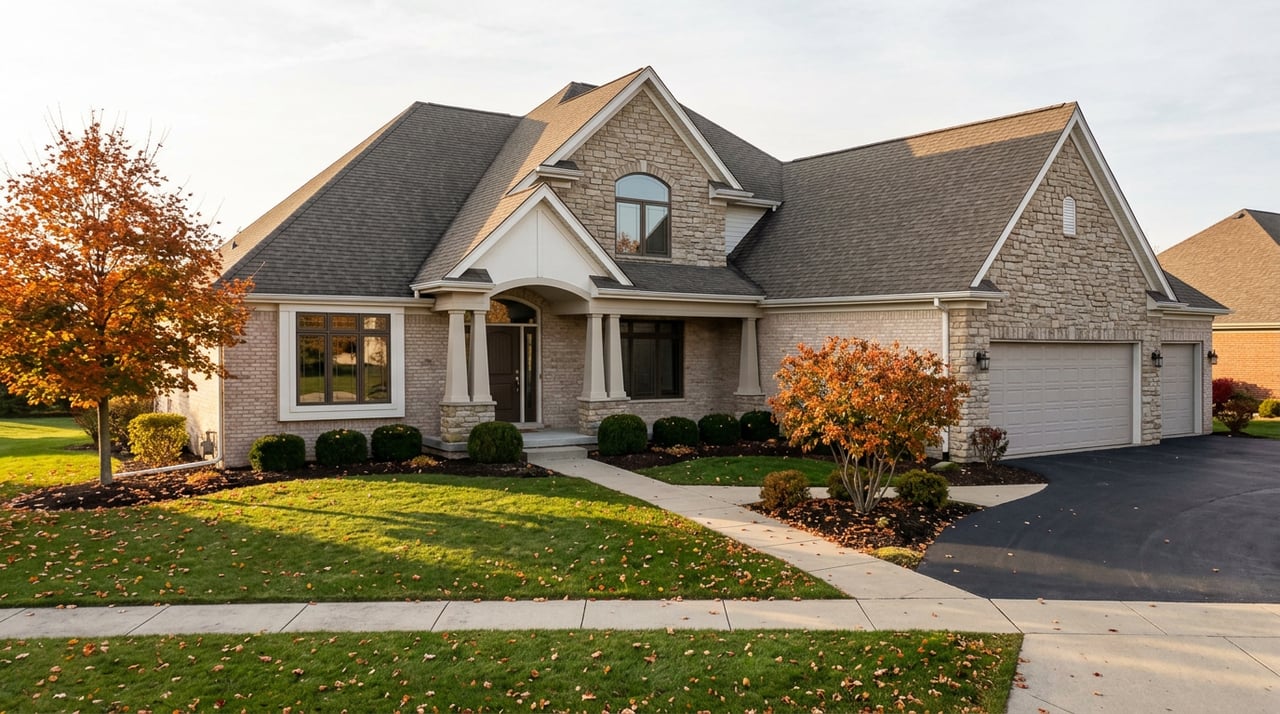
A Wind Point seller lists a home on Lighthouse Drive, prices it fairly against recent comparables, and expects the kind of quick turnaround that Racine County's broader market has seen this year. Instead, the listing sits. Not because buyers aren't looking. Because somewhere between the accepted offer and the closing table, someone asks a question the seller can't immediately answer: when was the pier installed, and does anyone have the paperwork?
That single question, more than any other factor, explains why lakefront transactions in Wind Point routinely take longer than the market average. It isn't a demand problem. It's a documentation problem, and it's specific to a village where every home has a Lake Michigan address and almost none of them have a clean paper trail on their water-facing improvements.
The market number that doesn't match the appeal
Wind Point is not a hard sell. It's a 1,700-person village bordered on three sides by Lake Michigan, home to the 108-foot Wind Point Lighthouse and Wingspread, the Frank Lloyd Wright-designed residence now used as a conference center. As of June 2026, the Zillow Home Value Index for Wind Point stood at roughly $431,000, up about 1.4 percent over the prior year. That's steady appreciation in a desirable enclave, not a market in trouble.
But the time-to-sale numbers tell a different story depending on which window you look at. One trailing twelve-month dataset put the typical Wind Point home at 135 days on market against a national average of 53. A separate snapshot from January 2026 put it closer to 80 days. Both numbers sit well above what a comparable inland home in Racine County would take to sell, and both are consistent with a market where inventory is thin, most listings are unique, and buyers are doing more homework before they're willing to sign.
That homework centers on one thing: whether the shoreline improvements on the property, the pier, the riprap, the seawall if there is one, can be verified, transferred, and maintained without a fight.
Why the pier's age matters more than its condition
Wisconsin's Department of Natural Resources draws a hard line at April 17, 2012. Any pier placed in the water before that date is exempt from DNR permitting entirely and doesn't need authorization to stay where it is. Anything installed after that date has to meet the DNR's current Pier Planner design standards, covering things like width, boat slip count, and how far the structure extends from the ordinary high water mark, or the owner needs an individual permit on file.
For a buyer, that means the first real question about any Wind Point lakefront listing isn't "how's the water view" but "when was this pier put in, and can you show me the exemption paperwork or the permit." For a seller, it means the file you need to assemble before listing isn't just the roof and furnace receipts. It's proof of when the pier went into the water, which determines whether the next owner inherits a grandfathered structure or a compliance question.
| Pier scenario | What's required | Who verifies it |
|---|---|---|
| Placed before April 17, 2012 | Exempt, no DNR permit needed | Owner should have some record showing placement date (old photos, tax records, prior listing history) |
| Placed after April 17, 2012, meets current design standards | Exempt under current Pier Planner criteria | Owner or agent checks dimensions against DNR standards |
| Placed after April 17, 2012, doesn't meet standards | Individual DNR permit required | Permit must exist and be transferable; missing permits become a closing issue |
Sellers who can hand over this documentation before an offer is even written save weeks of back and forth. Sellers who can't often find out during inspection, which is the worst possible time to be sorting through decades-old receipts.
What a neighbor's seawall means for your closing
Piers aren't the only shoreline structure that shows up in Wind Point due diligence. Riprap and seawalls carry their own permitting path, and it's a heavier one. Any new shoreline erosion control structure on the Great Lakes in Wisconsin requires an individual DNR permit, not a general exemption, because the engineering involved (wave heights, storm surge, sediment movement) has to be assessed case by case.
There's a reason buyers and their inspectors ask about this closely. In Ozaukee County, just north along the same Lake Michigan shoreline, a $12 million seawall and bluff-stabilization project completed in 2007 by Concordia University Wisconsin ended up in litigation. Neighboring landowners sued in 2011, arguing that the massive structure had worsened erosion on their own properties by cutting off the natural flow of sand along the coast. It's a well-documented example, reported by Wisconsin Watch and Wisconsin Public Radio, of how one property's armoring decision can become another property's problem.
Wind Point sits on a stretch of Lake Michigan shoreline that a 1979 Wisconsin coastal erosion study specifically flagged as a critical area, grouping it with the shoreline near the Oak Creek Power Plant. That history doesn't mean every Wind Point property has an erosion issue. It does mean that when a listing includes riprap or a seawall, buyers and their engineers are going to want to know when it was built, whether it was permitted, and whether it's held up. A structure installed 15 or 20 years ago without a clear permit trail can turn a straightforward closing into a multi-week engineering review.
The deed controls, not the assumption
There's a legal wrinkle here that surprises even experienced buyers moving from inland properties to Great Lakes frontage. Wisconsin restored a presumption of riparian rights for waterfront owners in 2021, meaning most lakefront property comes with the right to place a pier and use the adjacent water unless a deed says otherwise. But that "unless" matters. If a deed explicitly states the property doesn't carry pier rights or isn't considered waterfront for these purposes, that language controls, and the 2021 law doesn't override it.
This is why a title search and a careful read of the deed language belong on every Wind Point lakefront buyer's checklist, not as boilerplate but as an actual step someone completes before the offer deadline. Wisconsin's Real Estate Condition Report also requires certain shoreland-related disclosures, including any mitigation plan a seller has agreed to as part of a zoning or permitting process, since those obligations run with the land to the next owner.
None of this is designed to make Wind Point sound complicated for the sake of it. The village's shoreline, its lighthouse, and its architecture are exactly why people want to live there. The point is that the extra weeks a Wind Point sale spends on market usually trace back to paperwork, not to hesitant buyers.
Before you list or make an offer
For sellers, the file to build looks like this:
- Any record showing when the pier was originally placed, especially if it predates April 2012
- Copies of any DNR permits for the pier, riprap, or seawall, or documentation showing the structure is exempt
- The deed itself, checked for any language limiting riparian rights or pier rights
- Records of any mitigation agreements tied to shoreland zoning, since these must be disclosed to buyers
For buyers, the questions worth asking before writing an offer:
- When was the pier installed, and is there a DNR permit or exemption on file
- Has any shoreline armoring been added, and if so, when and under what permit
- Does the deed carry standard riparian rights, or does it include limiting language
- Has the seller entered any mitigation agreement tied to shoreland zoning that will transfer to the next owner
A property that comes with clean answers to these questions moves through underwriting, inspection, and closing at a pace much closer to the rest of Racine County. One that doesn't can still close successfully, but it takes the kind of patient, detail-oriented negotiation that a two-person team with deep local ties is built to handle.
Quick answers for Wind Point buyers and sellers
Does every Wind Point property have riparian rights? Most do, under the presumption restored by Wisconsin's 2021 law, but the actual deed controls. If the deed specifically limits or excludes those rights, that language stands.
Do I need a permit to keep an existing pier? If it was placed before April 17, 2012, no. If it went in after that date, it needs to meet current DNR design standards or have its own individual permit.
Is a seawall a dealbreaker? Not on its own. It becomes a closing issue when there's no record of when it was built or whether it was permitted, since new shoreline armoring on the Great Lakes requires an individual DNR review.
Buying or selling on Wind Point's shoreline comes with more moving parts than a typical Racine County transaction, but none of them are unmanageable with the right preparation. If you're weighing a move here, or you're ready to list and want the paperwork gathered before the first showing, the Tony Veranth Team can walk through exactly what your property's file needs before it goes on the market. Request a free consultation and home valuation to start.